
Engine overheating: what to do on the side of the road and what usually causes it
When an engine overheats, turn off the air, turn the heat on full, pull over somewhere safe and shut the engine off. Never open a hot radiator cap. Low coolant, leaking hoses, a bad radiator, a stuck thermostat or a dead fan are the usual causes. Once the car is home, Josh Anderson of Engine Doctor can come find the cause in your driveway in Kansas City, Kansas. Call or text (913) 256-5056.
- First move
- Air off, heat on full, pull over
- Never
- Open a hot radiator cap
- Getting home
- Have it hauled rather than drive it hot
- Call or text
- (913) 256-5056
When the needle starts to climb
Once the engine is warmed up, most cars keep the temperature gauge in about the same spot every day. If it starts moving toward hot, a warning light comes on, or you see steam from under the hood, act right then. Every minute the engine runs hot adds to the damage.
- Turn off the air conditioning. It adds heat and load to the engine.
- Turn the heater to its hottest setting and the fan on high. It feels awful in a Kansas City July, but the heater pulls heat away from the engine.
- Find a safe place to pull over, well off the road. On I-70 or I-435 that means the next exit or a wide shoulder.
- Shut the engine off once you are stopped.
Hands off the radiator cap
A hot cooling system is under pressure, and the coolant inside is hotter than boiling water would be in an open pot. Open the radiator cap or the reservoir cap while it is hot and that coolant can blast out and burn you badly. Don't do it, even with a rag over it. Wait until the engine is cool to the touch, which takes a good while.
Be careful lifting the hood too. If steam is pouring out, give it time first, and keep your face and hands back when you do.
Once it is cool, look at the see-through coolant reservoir. Empty or low is a clue. If you add coolant, use the type your owner's manual calls for, only with the engine cool, and watch for drips under the car afterward.
Getting the car home
It is tempting to let it cool, top it off and keep going. Sometimes that gets you home. Often it gets you a few miles before the needle climbs again, and every round of overheating stacks more damage on the last one. If the gauge climbs as soon as you drive, or you have nothing to add, have the car hauled home instead of driving it.
Once it is in your driveway, it can stay there. Josh comes to you, so the car doesn't have to be driven anywhere to find out what went wrong. If the engine got very hot before you stopped, tell him when you call.
The usual causes
Overheating is a symptom. Something stopped the cooling system from moving heat out of the engine, and it is usually one of these.
- Low coolant from a leak at a radiator hose, the radiator itself, a gasket or the heater core. Look for a brightly colored puddle and a sweet smell.
- A radiator that is clogged inside, blocked with bugs and debris outside, or cracked at the plastic tanks on the ends.
- A radiator hose that has gone soft, swollen or cracked, or a clamp that has let go.
- A thermostat stuck closed, which keeps coolant trapped in the engine and away from the radiator.
- A cooling fan that doesn't come on. The car runs hot in traffic or at idle, then cools off at highway speed.
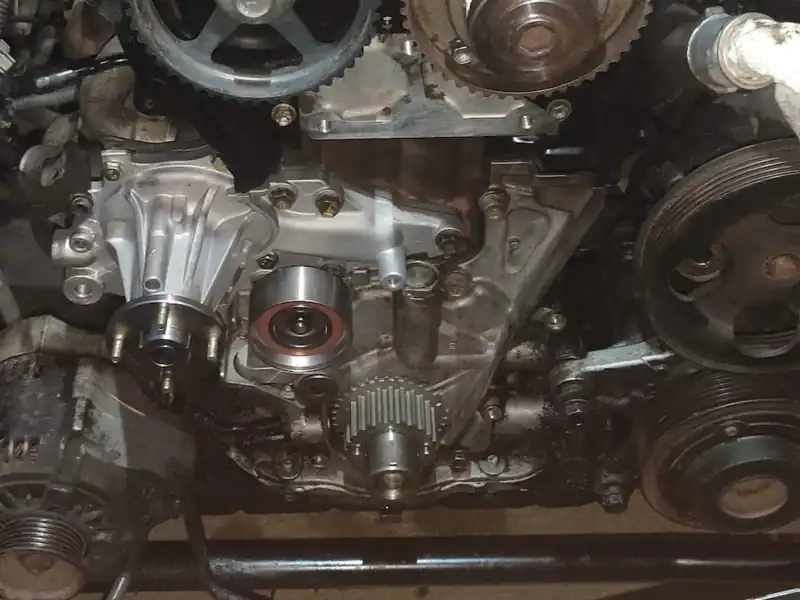
- A water pump that is leaking from its weep hole or whining from a worn bearing.
- A broken or slipping serpentine belt, or a worn tensioner. On many cars that belt turns the water pump.
- A radiator cap that no longer holds pressure, so the coolant boils over sooner.
- A failed head gasket pushing exhaust into the coolant or burning coolant in the engine.
Which of these Josh handles
Several of those are on Josh's own service list: radiators, radiator hoses, coolant flushes, serpentine belts, pulleys and tensioners, and gaskets. He also does engine diagnostics, which is where an overheating job starts, because the fix depends on which part failed.
Some causes, like a water pump or a cooling fan, aren't on his list. He will tell you what he finds either way, and you get a clear quote for anything he does before he starts.
Why driving it hot ruins engines
Engines are built to run in a fairly narrow temperature band. Above it, the metal grows more than it was designed to. Aluminum cylinder heads, which a lot of engines use, can warp. A warped head no longer seals flat against the block, and that blows the head gasket. Oil thins out and stops protecting the bearings and cylinder walls the way it should. Keep going and the pistons can scuff and the engine can seize.
That is how a soft hose or a clogged radiator ends up as a head gasket job, or an engine replacement, which costs far more than the part that started it.
Summer around Kansas City is the hard part
July and August heat, stop-and-go traffic and the air conditioning running full blast all push a cooling system hard. Sitting in event traffic out by Kansas Speedway and the Legends on a hot evening is about as tough a test as a cooling system gets. A radiator that was barely keeping up in spring is the one that boils over in August.
Most of these problems warn you first: a slow drop in the coolant reservoir, a damp spot on a hose, a sweet smell after a drive, a needle that sits a little higher than it used to. Catch those early and the fix is usually smaller. Call or text Josh at (913) 256-5056 with what you are seeing, and he will look it over at your house with a clear quote first.
Questions people ask
Can I keep driving if my car is overheating?
No. Pull over and shut it off as soon as it is safe. Driving an overheating engine can warp the cylinder head and blow the head gasket.
Why is my car overheating when the coolant is full?
A stuck thermostat, a fan that won't come on, a clogged radiator or a slipping belt can all cause overheating with a full reservoir. So can a failing head gasket.
Why does my car overheat at idle but not on the highway?
That often points to the cooling fan. At highway speed air is forced through the radiator, but sitting still the car depends on the fan to pull air through.
Can I add water instead of coolant?
In a pinch, once the engine is cool, water can get you somewhere safe. Have the system filled with the right coolant mix soon, because plain water doesn't protect against freezing or corrosion.
How long should I wait before opening the radiator cap?
Until the engine and radiator are cool to the touch. If the upper radiator hose is still firm and warm, the system can still be under pressure, so keep waiting.
You get a clear quote before Josh starts, and the work happens at your house, on your time.
Josh Anderson, ownerBased in Kansas City, Kansas · Every day of the week, 6 a.m. to 10 p.m. Call or text and Josh gets back to you.